




This website has been running since 2006. I am now on my third weatherstation. I started with LaCrosse WS2300 which lasted for 8 years. It was replaced with a Gadget N96GY, sold by Maplins, which was one of the rebadged chinese Fine Offset Stations. I have now had to replace this with another Fine offset station as I can no longer get spare parts for it. The new weather station is a Aercus Instruments WS2085. This is another chinese Fine Offset station badged as Aercus Instruments and sold in the UK by Greenfrog Scientific. It consists of an indoor base unit and an outdoor, all in one, sensor unit. The base unit connects to the sensor unit using a 433MHz wireless link. Both units are battery powered. No mains supply comes with the base unit but it does have a power jack socket so you could source a suitable one yourself. This model does not have a touch screen so all setup is performed using the buttons on the right hand edge of the unit.
Base Unit

The Base unit receives and displays the readings sent by the outside temperature, humidity, wind and rain unit. This happens every 48 seconds. The Base unit also records the indoor temperature and humidity. Although readings are received and displayed every 48 seconds they are not stored in memory this often. The base unit can store up to 4080 sets of data. By default the record interval is 30 minutes. This cannot be changed using the buttons on the unit. It can only be done by using the computer link and suitable software. With the recording interval set to 10 minutes this allows the unit to store at least 28 days of data before it needs to be downloaded to a computer.
No software is supplied with the weatherstation. Instead there is a link to Green Frogs website where you can download a free copy of EasyWeather or the old version of Cumulus. Its interesting to note that on all the packaging and website images Cumulus is shown with the weatherstation as if it is somehow linked to Fine Offset or Green Frog.
Timekeeping for the base unit is controlled by it's own internal clock. There is no radio controlled timekeeping.
The base unit allows the setting of alarm values for all readings and for a storm warning. As well as displaying the data from the sensors it calculates dew point and wind chill values and stores max and min values since last reset. It also measures and displays relative and absolute pressure and rainfall over the last 1 hour and 24 hours.
Connection to a PC is via a supplied USB cable. Green Frog, and the manufacturers instructions, do say that the unit is not supposed to be connected permanently to a computer or it can become unstable. My previous weatherstation was also a Fine Offset station and used to lose the USB link sometimes but never became unstable or corrupted data so I intend leaving this unit permanently connected to my laptop. I will let you know if this proves a problem.
Wind vane & anemometer

The wind vane and anemometer are built into one end of the main sensor unit. Im not really a fan of these all in one units as it makes it impossible to replace an individual faulty sensor. The only spare parts seem to be replacement anemometer cups or a new wind vane. If something goes wrong internally you will have to replace the whole unit at around £50.
The wind vane registers one of 16 possible compass directions and is free to rotate through 360 degrees. The anemometer is a conventional cup style. I don't know how these work internally but as I cannot hear any 'clicking' when they operate I suspect they don't use reed switches but some type of optical sensor or possibly a hall effect sensor.
Rain sensor
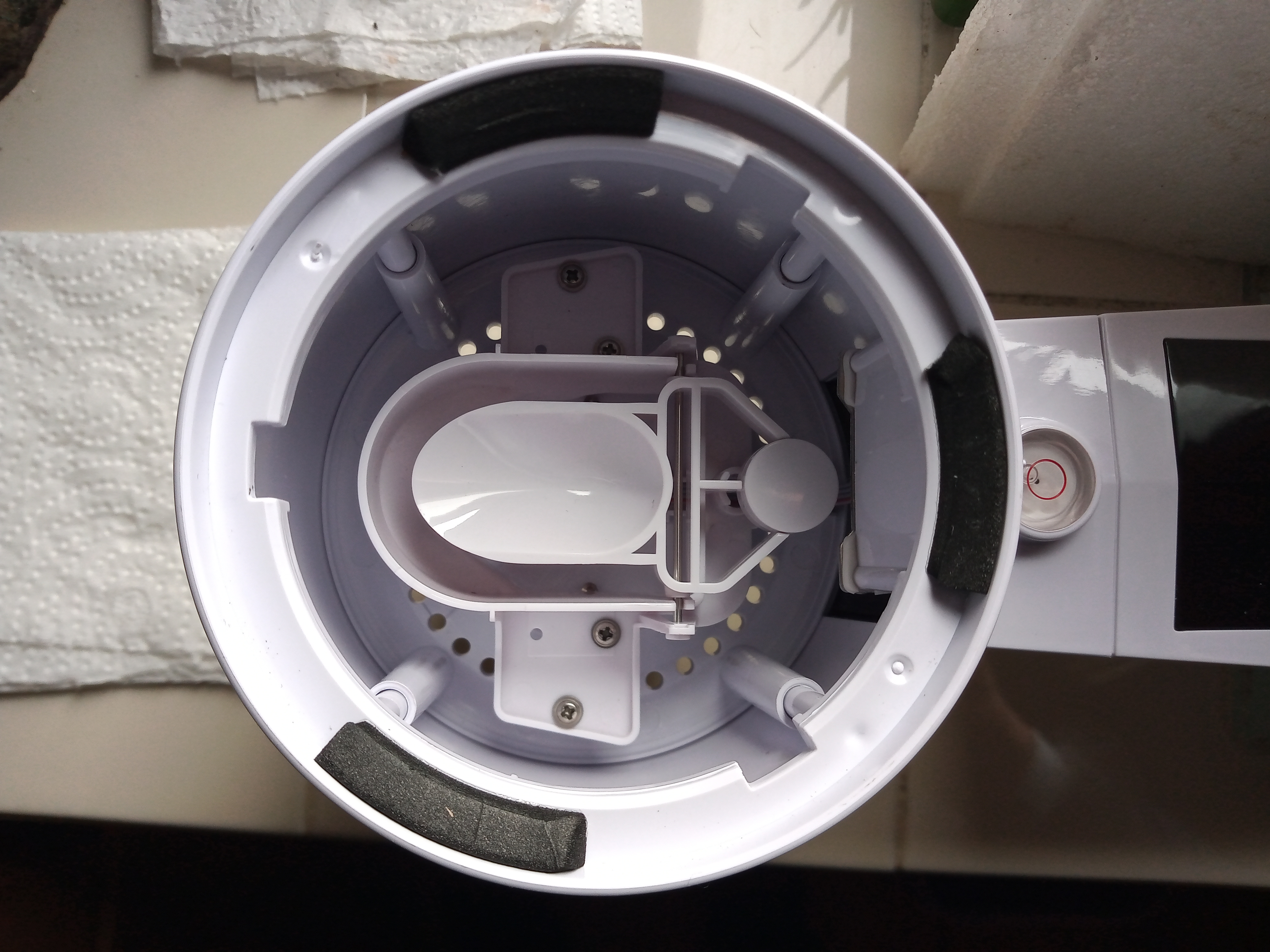
The rain sensor consists of a funnel that collects the water and directs it to a tipping bucket.When the bucket is full the weight of the water causes it to tip over and empty. Each tip is registered by a magnet activated switch. Each tip corresponds to 0.518mm or 1/200th of an inch of rain. As it is part of the sensor unit it has to be mounted on the pole. This can make it susceptible to wobble causing over reading. It is therefore important that a sturdy pole is used.
Temperature and humidity sensor

The temperature and humidity module is mounted under the rain sensor. It measures the outside temperature and humidity of the surrounding air. It's placement is critical to accurate recording. It must not see any direct sunlight so is covered with a plastic shroud. It must also have free air movement around it.
The whole sensor unit is designed to be mounted on a scaffold pole. Note that the pole cannot pass through the unit. There is no hole in the unit to allow this. The unit sits on the flat end of the pole. Smaller diameter poles such as those used to mount TV aerials are unsuitable. My unit is mounted on a 3 metre pole fixed to the side of my garage roof. Overall it is about 16ft high. This is insufficient to get it above the turbulent air created by surrounding objects. We are also surrounded by mountains which funnel the wind into different directions from the general flow so readings can only be taken as a guide to the general direction. So far it as survived the welsh weather. The highest recorded gust so far has been 68.2mph
Computer
Initially, the weather station was linked to my 'everyday' desktop computer. This was a 2.8Ghz P4 running Windows XP. Amazingly, the weather software consumed nearly 30% of the CPU's resources when running. The PC uses about 100W of electricity when in 'standby' mode, i.e. with the monitor off and the drives stopped. I had a hunt around for a cheap laptop to dedicate to the weatherstation and found a Dell Latitude CPi going cheap. This only had a 400Mhz PII processor, 128Mb of memory and a 6Gb hard disk running XP. It took a full 5 minutes to boot up and load all the software, but once running coped with Heavy Weather and Dorgem (webcam software) OK although it sometimes didn't find the webcam USB port when booting. It only consumed 9-10 Watts and had the advantage of battery backup in case of power cuts, which are not uncommon up here.
In October 2008 I updated the laptop to another Dell, this time a C610. This has a 1GHz Pentium III processor, 256 Mb of memory and a 12Gb hard disk and runs Windows XP again. As of January 2009 I am leaving this laptop running 24hrs a day.
Back to Home page